Archive for the ‘work’ Category
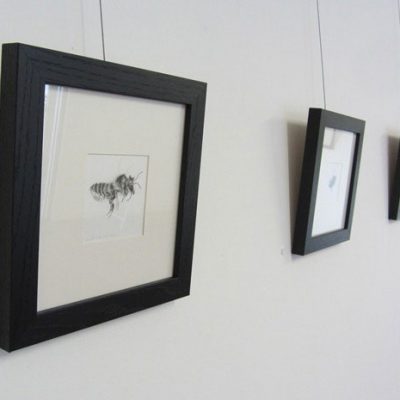
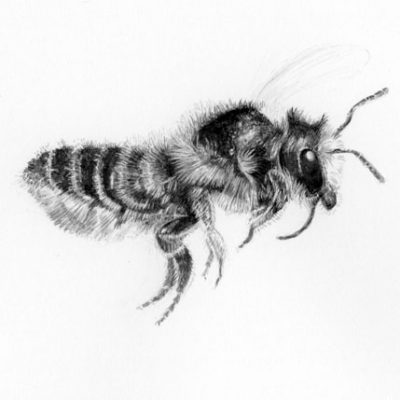
Latest bee drawings
Once again there seems to be a huge amount to report both on the drawings, and the activities of the bees in the garden. For those waiting for an update on the leaf-cutter bees, there is a post coming soon, with many photographs! There are also a few pen and ink drawings of leaf-cutter bees below. For those looking for my drawings, this post covers those I’ve been working on since my last update. I’m still in the experimental stage, as you will see, but eventually I will have drawings of bees for sale, as well as illustrations for the planned book about the bees.
The materials I’m using can be seen in the first picture below left, and are: the Gillott 404 nib and dip pen, Windsor & Newton Liquid Indian Ink, a Windsor & Newton Cotman fine brush, distilled water, a lint-free cloth to clean the nib, blotting paper, and a mixing palette for the ink wash. All the drawings shown in this blog post are on Bristol Board: some on Strathmore smooth Bristol board which has a nice off-white tone, while others including this large white foxglove drawing are on the bright white Canson Bristol Board.
An outdoor sketch of white foxglove, with bee visitors:
Above: For this drawing I left the studio and took my pen and ink kit onto the decking where I had a good view of a white foxglove which was being visited by many bumble bees. Above centre and right: two closer views of the drawing. I sketched the foxglove itself, adding a quick impression of each bee visiting the flowers during the hour or so I was there. As you can see the bees tend to repeat the same pattern of flight, visiting each flower in turn usually for a quick inspection and only sometimes entering a flower for pollen and nectar.
A purple foxglove with raindrops and a bee:
Above: For this drawing I worked in the studio from a reference photograph on the computer screen. I have found that this is more successful than working from a printed photograph, as it allows me to zoom into the image when necessary to check a detail. Somehow the light in the computer screen also helps to reveal some quality which seems to be lost when something is printed. For this drawing I sketched the outlines in ink, then using distilled water and a fine brush drew the ink out of the lines to create shading. This is possible with Windsor & Newton Liquid Indian ink as it is not waterproof. For the darker areas I added more and more ink in washes.
Another outdoor experiment: bees on thyme:
Above left: I sat for a while in the sunshine watching three or four honey bees working on a thyme plant just outside my studio. This time I tried to capture the positions and activities of the bees, and left the plant as a few lines which indicate the position of the main stems. Not surprisingly, I found drawing these bees very difficult – they are so small and move quickly, and there is hardly time to capture more than the position of the wings or a leg. However, after a short while the patterns the bees make in their explorations become clear. I intend to repeat this experiment again soon as I feel I was just getting somewhere when the paper became too crowded with bees to continue. Above right: detail of one of the bees from this drawing.
These same bees, drawn at the computer screen:
Above left: I have been taking many pictures of bees this summer, and these help me to understand the way these insects are put together. So I took plenty of photographs of the bees on the thyme which featured in the drawing above. Here I am working from the computer screen, as I did for the drawing of the purple foxglove above. A combination of observation, drawing the bees ‘live’, and working from photographs in this way is helping me to get a good result with the drawings. Above centre and right: more detail of these sketches. As you can see I am using very little wash on these bees, and concentrating on the lines.
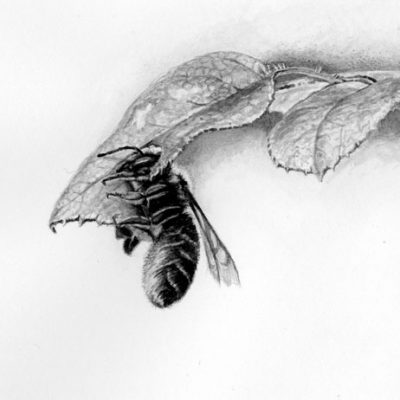
A leaf-cutter bee carrying a leaf:
Above: A leaf-cutter bee carries a furled piece of rose leaf into its nest. As with some of the other drawings above, I’m working here from a photograph I took this summer displayed on the the computer screen. The drawing is in the same materials as before, and on Bristol Board. This is a nice preview for you bee fans out there, as I have many photographs to share with you of this bee building her nest. I drew this completely in pen without any pencil sketch, as in all the drawings above. I wasn’t too concerned about the exactness of the anatomy, but was rather aiming for some animation and variety of line.
And finally, perhaps too much detail:
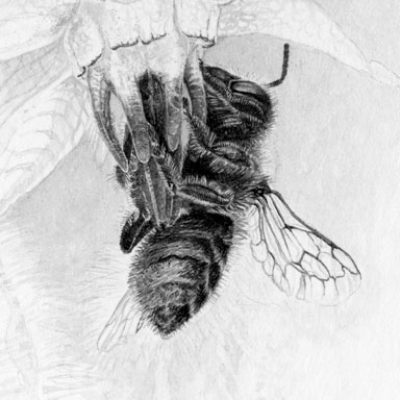
Above: Once again, as in an earlier post on my bee drawings, I have been wavering between a freer drawing style and recording exact details as in this drawing of a leaf-cutter bee at rest. This drawing was traced from an earlier sketch – hence the pencil marks. I hoped in this way to get a more anatomically correct result, but I perhaps took things a little too far in getting out my magnifying light and trying to record every single hair! The result looks a little stationary even for a resting bee, I think. However, I do like the close-up view above right, so I believe I’ll save the magnifier for when I’m drawing a detailed portion of a bee rather than an entire specimen. If you click on the thumbnail image above right, you will see that it’s possible with the Gillott 404 nib to stipple and produce lines as fine as those with the Rapidograph.
So at the moment I’m working on something midway between the “correctness” of this final leafcutter drawing and the animation and freer style of the bee carrying the leaf. I will continue to use the dip-pens as I’m quite pleased with some of the results I’m getting.
The next blog post will be mainly about the leaf-cutter bees and what they’ve been up to since we saw them last. Thanks for reading, and thanks also to those who have taken the time to comment or to email me about their bees. There are a lot of people with leaf-cutters in their garden, it seems!
| Home | About the Artist | Contact | Galleries | Writing | News |
Bees in pen and ink: Dip pens
Here are my latest drawings of the bees. Earlier posts showed my sketches of ’bee characters‘ as well as some bee drawings using the Rotring Rapidograph. Here I’m using a dip pen to draw in detail the head of a bee.
Dip pen and Indian Ink:
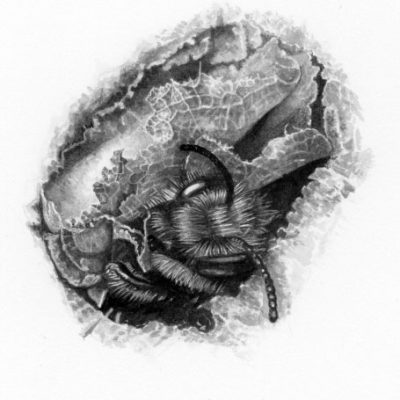
Above: The drawing is from a photograph of a leafcutter bee emerging from the nest, which I took I think in 2009. The nib I’m using is the Gillot 404 which I used for the ‘bee characters’. I was surprised to find that used carefully and slowly I can achieve quite a lot of detail, as you can see if you click on the thumbnail images above. The ink is again the Windsor and Newton Liquid Indian Ink, which is non-waterproof. I have found it is ideal for this work. I use a very small amount of ink on the nib each time, dipping a very little way into the ink, or applying with a small paint brush. This way I have found there have been (so far!) no disasters with blobs of ink, and it flows almost like using a pencil, if the nib is used gently and relatively slowly. Every so often, once the ink starts to dry on the nib, I rinse the nib in a small cup of water and dry it on a lint-free cloth. Paper is Bristol Board.
This is the technique I’ll be using for a while now on the bees. Despite being quite slow work, it is in fact much quicker than drawing with the Rapidograph. It also allows me to make a variety of marks including stippling, and the lines also have more variety of thickness.
Above, left: Some quick sketches of a newly-emerged leafcutter. Above, centre and right: close-up views of a larger study of a leafcutter bee, showing the variety of lines used.
Above: Gillott nib looking slightly worn – I just hope that when I start using the next one it gives me the same results, or I’m going to be very disappointed!
The close-up of the nib above was taken with my new compact camera, which I’m hoping to use to take some better photographs of the bees. I have been struggling with the older photographs of the bees I’ve taken, since they don’t have the detail that I want to record in these drawings. At the moment I’m enjoying the weather, chasing insects around the garden and getting used to the camera. I have been really pleased to find miner bees digging in my garden for the first time this year. I don’t know whether I’ve missed them before, or they’re here for the first time.
I’ll post a few of the new pictures in the photography part of the site soon. For now, there is a link below to take you to some of my earlier photographs, and information on the solitary bees.
| Bee Pages with photographs and illustrations |
| Home | About the Artist | Contact | Galleries | Writing | News |
Bees in pen and ink: Bee characters
Something of a different take on the bees, and probably as far removed from the Rapidograph drawings as I can get.
A label:
Above: Back in February I did a couple of quick sketches of bees on labels and cards for a gift. It was just a little sketching, using the same nib I used to address the envelope. But I realised that these bees had all the character I was looking for in my more serious drawing, and I think this is where the idea for the bee characters originated.
Bee characters – a few early drawings:
Taking notes one day from one of Fabre’s bee books, my mind was wandering with regard to what the bees might think of our notions about them, and I found myself doodling these bees on the page.
Above left: First doodles with gel pen in my notebook. Above, centre left: Work on the bees using the nibs I’d been using to practise my writing, and Indian Ink. After a little experimentation I found that the Gillott 404 nib with Windsor & Newton liquid indian ink were ideal for these tiny sketches, as you can see from my note on the page. This ink is less ‘sticky’ than the Indian Ink I’ve always used before, and I’ll write more about that in my next blog post on the bee drawings. Above right: Two shots of a couple of the early characters – the one with the pen gives an idea of scale. I added some ink wash, as you can see.
Above: Combining some of my lettering with the bees. This combination of lettering and small drawings is one I’ve been using on my family trees. Since these first efforts I’ve drawn many more ‘characters’ engaged in photography, writing their own books, looking through telescopes and what not. Not sure where it’s all going, but it’s fun playing about with them!
My next post on the bee drawings should be up next week, and looks at my most recent drawings using the dip pens – a return to more ‘serious’ bee studies.
| Home | About the Artist | Contact | Galleries | Writing | News |
Bees in pen and ink: Rapidograph
I’ve been meaning to update the blog for some time, to show the drawings I’ve been doing of bees. I hadn’t felt there was much to write about, but looking back over the material, I realise I should have updated everything a lot sooner. Since there seems to be too much material for one blog post, I’ve split it into three. Here’s the first – about the bees in Rotring Rapidograph.
Those of you who follow the blog will know that I encourage solitary bees to the garden and am always photographing and writing about them. I have an idea to write a book about the Leafcutter bees in particular, which would be either an ‘Artists Book’ with most of the focus on the drawings, or else more philosophically-based, with the drawings serving more as illustrations.
I also have a lot of straightforward information about solitary bees which I will probably put on the website in some form or another. I’ve put a link to all the bee information on the website at the moment - blog posts, web pages, photographs and drawings – on the menu at the right, or you can go straight to it here: Bee Pages.
Rapidograph Bees
Dining Room Chair – detail of the Ivy:
Above: A detail from the drawing Dining Room Window and Chair showing the view through the lower part of the window – an ivy, which is always covered in honey bees during its flowering season. This was one of the first times I had included bees in my work, though I am often photographing and writing about them. I decided to use the photographs as the basis of some drawings which would focus on the bees themselves.
A Leafcutter bee using Rotring Rapidograph:
Above: This first study was a straightforward drawing using the Rotring Rapidograph, mainly stippling but also using fine lines for the hairs. As you can see above left, I had begun by making a sketch of this bee in pencil. For the ink drawing I began by drawing the outline of the bee and flower in pencil. But the more I worked on the bee, the more I felt it was too ‘stationary’ and not at all what I wanted from a study of so lively a creature!
I also had the difficulty of rendering the flower petals; so easy in pencil, but too time-consuming for the number of drawings I’ll need for the book. I decided to experiment with some looser sketches in Rapidograph pen, leaving aside the preliminary pencil drawing, and being freer with the marks used:
Rapidograph sketch of a newly-hatched Leafcutter bee:
Above: Sketches of a bee in Rapidograph (0.13). Of course abandoning the preliminary drawing meant there would be plenty of mistakes. But I think this was good for me, since I’m so used to meticulously drawing everything out in pencil before I begin. It also helped with my beginning to understand the anatomy of the bee. I think this bee comes alive and off the page in a way that the earlier bee did not.
Once I’d sketched the bee in ink, I used a combination of stippling, dashes and other small marks for the details. I think I went on to fiddle about using a little ink wash, and some dried India ink on cotton buds. This wasn’t particularly successful in terms of a beautiful image, but I think the experiment worked in that it moved me away from so much reliance on the time-consuming stippling.
Adding ink wash:
Above: And finally for this post, a page from my tentative experiments with ink wash on the petals. The bees themselves were mainly drawn with the Rapidograph. I say ‘wash’ but I’m still trying to control everything too much, and I need a lot more practice. I really had to push myself to try out all these different ideas after being wedded to the stippling for so long! I’m still somewhat uneasy sharing my ‘mistakes’ and experiments, as all I can see are problems that still need work.
After a while I decided that the Rapidograph wasn’t giving me the lines I wanted, and neither did it blend well with either the wash, or in combination with pencil leaves and petals. Something else was needed, and so I put down my Rapidographs for the time being.
| Home | About the Artist | Contact | Galleries | Writing | News |
Dining Room Window and Chair – complete
Dining Room Window and Chair, 2010
At least, more or less complete. There are still a few small, dark clouds I will add lower down near the chair at some point. But I thought I’d post the drawing as it is now, since a few people have asked me about it. It took months to complete, not only because of the amount of detail, but because I unfortunately suffered from a frozen shoulder, migraines and other illness during the process. It has been in a drawer for quite some time now (since my last update!), and only now am I able to look at a scan of it and think, yes, I’m almost happy with this.
This was by no means my first stipple drawing, but nevertheless I learnt quite a lot along the way, especially in the use of patterns in the stippling, which I found very effective in the skies. I will write more about the drawing at a later date, when I have a little more perspective. In the meantime, here’s a recap on the progress of the drawing in my blog.
A larger image of the drawing in full can be seen here: Dining Room Window and Chair.
| Home | About the Artist | Contact | Galleries | Writing | News |
About the bees I
I thought I’d update with some news about the bees – both those in the garden, and on my drawing table. However, as this post became quite long in the writing, I have decided to put the new drawings into a separate blog post (coming soon).
Improving the solitary bee houses:
Late last month I decided to improve the site of the solitary bee nests, both enlarging the number and type of nest available, and moving them from the decking, as I think that the vibrations caused by people walking about discouraged the bees last year. Above left I’m drilling holes in the untreated wood, then tidying up with sandpaper. Finally above right is the new site of the nests, sheltered under the roof of an old hedgehog house, and resting on some bricks for stability. Read more about making solitary bee houses in these new sections on the Solitary Bee Houses and Leafcutter Bees.
A tired bumblebee:
Temperatures have been increasing over the past weeks, and bee activity in general increasing with bumblebees and honeybees flying in and out of the garden. I have never been able to get a bumblebee to nest in my garden, so I have to make do with their passing visits. Last week I rescued a buff tailed bumblebee which I found in the house, upside down and appearing quite dead. However, her legs waved weakly when I touched her, and so I righted the bee in a dish and supplied her with sugar water. Above left you see the bee, and the tongue clearly against the glass and white paper of the dish. Centre: the bee rests on some fencing material before finally flying off about twenty minutes after I found her in the house. The bee above right in the fritillary was photographed a few days later – not the same bee, but quite engrossed in what she’s doing!
Some solitary bee activity:
This past Saturday there was a very warm sunny morning and many types of bees could be seen flying above the solitary bee houses, resting occasionally on the bamboo plants, where I managed to photograph a few! It was not an easy task, given that it was quite breezy and the bees were darting around very quickly in between brief rests on the leaves. But even when the bees settled it was difficult to focus on the small bees on the waving bamboo, as you can imagine. A photograph below shows the clump of bamboo which is above the nests – the bees were darting in and out of it most of the day. Click on the thumbnails for more detail.
These are not the Leafcutter bees, who will not make an appearance until early June.
The bee above left was a beautiful red colour, and the centre left shot shows the mouth of this bee, which seems built for rolling mud balls, and so I think this is a red mason bee (update – this is a tawny mining bee, identified from photographs here). Centre right a bluish bee – do you have any idea what it is? I saw both these bees (or perhaps more than one?) a few times during the afternoon. Most common was the bee above right, which was present most of the afternoon, and there seemed to be several of them. I am still finding it quite difficult to identify the various types of bees, despite referring to guides and identification charts and photographs. There are so many variations of colour and shape, and every species seems to look different from photograph to photograph! I’m still very much learning how to tell one bee from another, so if you can identify any of these bees I’d love you to get in touch – email link is below, or there is a tab above for making comments – thanks in advance!
Other bees, flies and wasps were also enjoying the sunshine. Including this honey bee, below centre, which can be identified by the pollen sacks, and this below right, which I think is a Narcissus fly, doing a very good impression of a bumblebee.
Fabre’s Mason Bees:
Finally, for now, a little note about “The Mason Bees“, by Jean-Henri Fabre, which I spent some time reading last week. It’s a fascinating and engaging read, full of the observations and thoughts of this pioneering entomologist. It really is a series of essays which describe Fabre’s first enounter with the bees while he was a schoolteacher, and a number of his experiments and hypotheses. The entire text can be read in several places online, including here at Project Gutenberg.
An update to this page can be found here: About the bees II.
A post about the bee drawings coming soon!
| Home | About the Artist | Contact | Galleries | Writing | News |
Farmer family tree
Following on from my previous post on a family tree I drew for a friend, here is one of the sketches I’ve been doing based on my own family tree – click on the thumbnail for a closer look. I’ve used a dip pen for both the handwriting and the little sketches. I used a calligraphy nib for the handwriting, and a Gillot 404 for the sketches. It’s a lot faster than using the Rapidographs, but I’m quite nervous using them at the moment.
The sketches are based on some photographs I took of places connected with my family history. They are both public houses in Belbroughton, Worcestershire – my immediate ‘Farmer’ ancestors were maltsters and publicans. My Farmer cousins also lived in Belbroughton and Halesowen, and were farmers. They lived in various farm houses, most of them still standing, drawings of which I’m also going to include on the family tree when I’ve ‘finished’ researching it. Unfortunately the earliest farm house that I know they lived in up until the 1870s, ‘Howley Grange’ in Halesowen, was demolished to make way for a school. But there is at least one sketch of it in existence that I know of, to attest to its original appearance.
The difficulty will be in knowing when to stop researching and begin work on the finished drawing, knowing that there will always be further information coming to light which may alter the picture.
| Home | Contact | Galleries | Subscribe to Blog |
A family tree
I’ve really enjoyed the research I’ve been carring out on my own family tree for about a year now. So I was excited to be asked to help with some genealogy for a friend, who also wanted a drawing of the family tree to give as a gift. The research I found of course fascinating – it is hard to explain the joy of searching through those pages of census records, and the piecing together of family relationships from birth and marriage certificates. When it came to the drawing itself, I wanted to present the diagram as a ‘real’ tree, with bark and leaf details. I found it quite tricky to arrange all the ancestors in such a small space, and yet have their relationships readable. In the end this fan-shape seemed to work really well, both to present all the family members, while maintaining the overall shape of a gnarled old tree.
Above: Here are some photographs of the tree, to show some details of bark and leaves, as well as the fan arrangement of the entire tree. Click on any of the thumbnails for a closer look, especially of the entire tree, the overall shape of which can’t be seen in the thumbnail. To draw the tree, I first printed the names onto the paper in the fan arrangement, and then drew a border around each name. I then sketched the tree shape around them in pencil, while the final drawing was completed using a Rotring Rapidograph pen.
Above: The finished drawing was mounted and framed. A few weeks after I’d completed the drawing, I was completely surprised to receive a really touching note from the recipient of the tree, who was really happy with the results.
I plan to draw out some of my own trees in the same kind of way now, working on pedigree trees like this, as well as descendant trees, and all kinds of variations. I will also be adding little details such as drawings of places they lived, their houses, perhaps tiny maps, items connected with their trades, and so on. Not all of them will be based on ‘real’ trees, as I am thinking of using perhaps chains for my chain-making ancestors, as well as other ideas. I also want to experiment with dip pens rather than the Rotring pen, and to write the names out by hand.
| Home | Contact | Galleries | Subscribe to Blog |
Dining room chair and some smaller clouds
Above is the almost finished lower right hand section of the drawing Dining Room Chair and Window. As you can see there are still some pencilled-in clouds which I’m uncertain about at this moment, and there are more of them in other parts of the drawing. It will be a little while before I decide whether or not to ink in these dark clouds.
Above are some scans taken as this section of the drawing progressed. The landscape is an interpretation of the view from Clee Hill, with Malvern in the distance. As you can see, I was still changing my mind on the shape of some of the clouds quite late in the drawing. However, there is not much room for alterations, as with pen and ink once a mark is made it cannot be gone over and altered to make it lighter. Similarly, I was not sure about the foreground until quite late in the process, and had originally thought of having liverwort creeping into the picture. In the end I decided on these bare floorboards. Click on the thumbnails for a closer view.
And here above are some close-up views of the smaller clouds in this part of the drawing, and of the landscape. They give an idea of the patterns of stipples that I use to build up the image. The entire sky is made up of these stipples, which take a lot of patience and concentration to keep relatively even. It is a method of stippling the sky which I only began doing with this drawing – before this I had been stippling much more randomly. For some reason I find it immensely satisfying to make these patterns. The new drawing, which I’ll post some pictures of soon, includes stippled skies and clouds again, along with the ivy, and some new elements.
Earlier posts describing the progress of this drawing can be found here. They include a post about the photography for this drawing, when I took the dining chair to Clee Hill.
| Home | Contact | Galleries | Subscribe to Blog |
Finished clouds in the Dining Room Window drawing
Here is the finished sky at the very top of the drawing. And below are progress scans which show the development of the clouds. Click on thumbnails for a closer look.
I think that this drawing is almost finished now, but I will perhaps put some darker clouds lower in the sky before I’m happy with it. I’ll post some updates soon of other areas of the drawing, and when I think it’s complete I’ll post a picture of the entire drawing.
More on stipple drawing.
All earlier posts on this drawing, in which you can see how this area of sky fits into the entire drawing!
I’ve already begun my next drawing, which is considerably smaller, but is almost certain to feature clouds. More updates soon.
| Home | Contact | Galleries | Subscribe to Blog |