| Christine | Farmer |

Archive for the ‘solitary bees’ tag

Return of the leaf cutter bees

with 7 comments

You may remember that last year I had very little success with my solitary bee houses, and was surprised when a leaf cutter bee emerged from one of the old sealed tubes a few weeks ago. I put the lack of nesting last year down to the boxes being sited on my wobbly decking, and this Spring moved the bee houses to a more stable base, and hoped for the best.

And now, just a few weeks after I saw this first bee emerge, I seem to have three species of leaf cutter in my garden. I have never tried to identify my leaf cutters to species before, and it is quite difficult with these little bees. There are seven species of leaf cutter (Megachile) in this country. This site has photographs of all of them, but I’m still dithering over which is which in my garden! However, I am hoping to be able to identify them properly soon, having requested a back copy of British Wildlife Magazine (vol. 10, no. 6), which contains, I’m told, the best guide to leaf cutters currently available. Hopefully when this arrives I’ll be closer to knowing the species of my bees – so long as they can be identified from photographs, rather than via dead specimens and microscopes.

So, let me show you what I’ve seen in the garden so far!

A surprise hatching and an early arrival at the nests:

Above left: My unexpected hatching emerged from a narrow bamboo tube on 20th June, in need of a clean-up. You can read more about this hatching, with photographs, in a previous blog post. Above centre and right: Two days later I saw this bee with pollen all over its face, going in and out of one of the cardboard tubes of the bee house. From its size I would say it was the same bee. It has now been going back and forth into this tube for almost two weeks, carrying pollen on the hairs of the lower half of its abdomen, as can be seen in the right hand photograph. The presence of these hairs is an identifying feature of leaf cutter bees, but also of other types of bee such as the Osmia (see comments). These are the first few pictures I managed to caputure of this bee which is very quick in flight, coming out of the tube like a bullet out of a gun, so they are none too sharp!

After two weeks of observation I have yet to see it enter the tube with a leaf piece, and it is still working away deep in the tube, building up its nest slowly. Hopefully when it is finished I will be able to see what it’s building the cells from. It must be using very small pieces of leaf that I can’t see as it whizzes past. And I have still not captured on camera its front end as it enters the tube. Most of the leafcutters I have ever tried to photograph approach the tubes with great pieces of leaf and fly uncertainly at times, allowing a bumbling photographer a fair crack at a shot. This little bee flies almost straight into the tube!

Update: see pictures below and comments for a probable identification for this little bee as Osmia.

A beauty in the garden:

Above: Two days after I had noticed the small leafcutter had moved into the bee tubes, I spotted this bee on the pink flowers of one of the succulent plants. This is quite obviously a different type of bee, which is much larger and fatter than the one nesting in the tubes. I have seen this bee in the garden now for a couple of weeks, either on this succulent or on the borage flowers, but I have not seen it nesting or collecting leaves for its nest.

Another leafcutter at the bee houses:

Above left: A day or so after I first saw the beautiful fat leaf cutter on the succulents, I saw this similarly-sized bee investigating the bee houses. I only had a brief view of it the first few days. The weather wasn’t particularly good, and it was buzzing around and then flying off before I could even focus on it properly, as you can see. The thorax looked white with either pollen or sawdust from the tubes, so I could not be sure if it was the same bee a little the worse for its travel or an entirely different bee. It took me several days of watching both bees, and some much better photographs to decide that this was most probably a third leaf cutter species.

Above right and far right: The bees have a choice of tube to nest in at the bee houses. There are the cardboard tubes from the Oxford Bee Company (available at Wiggly Wigglers here), bamboo canes and sweet cicely stems of various thicknesses, some bored logs, and a bee block (far right). I’ll give a run-down on which bee has settled into which tube in a later post. You can see how close the bee homes are to my garden chair, which illustrates how safe it is to encourage them to your garden.

A bit of a clear out:

Above: On a sunny morning a few days later, I found the second fat bee clearing out one of the old bamboo canes which had been nested in a previous year. You may wonder why it is that these bees seem to prefer the labour of emptying a tube which has been nested in previously to using a fresh, unused tube, as I do! It is a task of several hours to remove all the old debris from a used tube, when there are what seems perfectly good clear tubes right near by. Above left: here you see her kicking some of the smaller bits of leaf and other debris back behind her onto the floor. The centre pictures show her dragging out a larger piece of old leaf. She flies a few feet from the nest to drop these larger pieces away from the site, but as there are often several pieces together due to the way the nest is constructed, some pieces fall below. This far right photograph shows the curvature of the old leaf pieces which were cut and positioned by a bee in previous years. More on the construction of these nests can be seen in this earlier post.

In the interests of identification, the second from left shot above shows that this bee has dark hairs on the last two segments of her abdomen, which is different from the all golden or yellow hairs on the ‘succulent bee’ above. This is the kind of detail which I am hoping will help me to identify the species when I receive my guide.

Above left: While all this clearing was taking place, the first leafcutter was zipping in and out of the cardboard tube just above this bee’s head. The smaller bee can just be seen poking it’s head out tentatively at one point. Generally speaking leaf cutters, as many other solitary bees including the miner bees, will live side-by-side and seem actually to prefer it to nesting alone, despite their ‘solitary’ name. However, I have noticed the bees having small spats, and I will describe some of these in a later blog post. The picture above left shows quite clearly the considerable difference in size between these two bees, which is one of the things I find difficult to envisage from descriptions in identification guides.

And some exploring – uncertain where to nest?

Above: After excavating the bamboo for quite some time, the bee decided to explore all the other options in the bee house. I don’t know whether she had found some problem with the bamboo, or what reason there was for this, since she eventually went back to finish clearing and start laying in the original place. But here you see her exploring the sweet cicely stems, and the cardboard tubes which were quite a squeeze for this bee, while the smaller leaf cutter can actually turn round inside these tubes. She then got herself covered in sawdust while exploring the drilled logs, and lastly exploring the bee block.

She also flew over the top of the nests several times and all around it, and then flew all around me to make sure I was not a threat. Eventually she began to settle again in her bamboo tube, which is where we will find her in a future post, since this one has become so long.

In the meantime, it’s still not too late to set up some tubes, or build a solitary bee home yourself. It really is worthwhile, since these bees do so many interesting things you can see right up close, and they are very unlikely to sting, and do not swarm or attack – see the bee pages for more information:

| Bee PagesAll about Bee Houses|

Update: Unexpected hatching bee a probable Osmia.


Above: Thanks to Alan who kindly commented on the photographs in this post it seems very likely that this small bee is not a ‘leaf cutter’ but another bee which uses leaves to construct its nest - an Osmia. See the comments for Alan’s ideas on this, in which he describes the way this bee uses leaves to construct its nest. The photographs above seem to confirm this identification. Above left: I managed to retrieve the plug which the first bee had pushed aside in hatching, and on close inspection it does indeed appear to have been made from chewed leaves (centre left). This is supported by the centre right picture, which shows one of these bees entering a tube with a tiny piece of leaf, which is not big enough to seal a tube on its own, and would need ‘stitching’ together in some way. Far right: The end sealing of this year’s nest appears to be of the same construction – chewed leaves.

| Home | About the Artist | Contact | Galleries | WritingNews |

Written by Christine

July 11th, 2011 at 12:12 pm

Unexpected hatching

without comments

Well I’ve been very busy drawing my ink bees and learning how to photograph insects! I have quite a bit to update, as ever, but for now I thought I’d report on an unexpected hatching at the leafcutter bee nests.

After the leaf cutter bees hatched last year, there was just a little interest in the nests before they were abandoned. I wrote in this post that I thought that vibrations from the decking had put off the bees from using my nests, and earlier this year I relocated them onto a stone wall which I built for the purpose. And hoped to at least get some bees nesting again this year.

I’ve had quite a few people asking in the past week whether they should start investigating their bee tubes, as they had not seen any hatch and it seemed to be getting quite late in the year, the leaf-cutters usually having hatched by now. Unfortunately I couldn’t make any comparison with my bees, as I thought I had none waiting to hatch after last year’s abandonment of the nests. However, this morning I noticed for the first time some leaf-cutters were using my new nest site, and I settled down to see if I could get any photographs. But it was late afternoon and the sun was not on the nest entrances, so things were quite dark and difficult for bee photography. And I’d forgotten just how fast these bees move! I resigned myself to no good photographs today, but will try again in the morning when the light should be better and in the right direction.


I haven’t seen any holes in my rose leaves yet, and none of the three bees I saw flying into the tubes were carrying leaf pieces, but were covered on their lower bodies with pollen. But as I observed the tubes I was surprised to see a shuffling in one of the old bamboo tubes which I thought had been laid into and not hatched two years ago (from the pen mark on the edge of the bamboo which I used to keep track of which tubes were sealed in 2009). It seemed as if the old plug, which I was sure was two years old, was being shoved aside by something inside the bamboo. Fascinated, I started photographing the tube, and was completely surprised when the jaws of a bee appeared.


I can’t imagine that this bee has been in there two years, so I must have missed this particular tube being re-used last summer. What a marvellous surprise, and how unfortunate that the light was so bad – almost every shot is blurry! However, I think you can just see enough to make out that the bee pushes the old plug away, rather than eating its way out in the usual manner. It then rests for a while, covered in old pollen and looking very unlike a leafcutter to my eyes (see note below). It was quite aware that I was there, and looked at me from several angles as I attempted to hold the camera still enough to get a decent shot in the poor light.


After a while the bee retreated into the bamboo, and emerged several minutes later looking slightly cleaner. It then came out of the tube, popped into another and turned round, having little clean-ups every now and then. After a while it was looking more like a hairy leafcutter, and took one final short rest on the nest before flying off into some nearby bushes and out of my sight.

Just a note on the date. I normally say my leafcutters emerge towards the end of the first week of June, so I would say that the bees are slightly late this year. So if you are someone wondering whether to start prodding your nests in case there are bees trapped along the tube, perhaps hold off!? Please leave comments below if you have bees hatching or not hatching or beginning to lay. I do have quite a few visitors looking for bee information and you may help someone along the way.

It’s not too late to build or set up some bee nests yourself this year. These are wonderful insects for children to observe as they are very unlikely to sting, and do not swarm. Read more about solitary bees on the Bee Pages:

| Bee Pages

Update: This bee has now nested in the bee houses, and from the nature of its nest it can be identified as an Osmia – see this post.

 | Home | About the Artist | ContactGalleries | WritingNews |

Written by Christine

June 20th, 2011 at 4:36 pm

Miner bees take up residence

with 2 comments

I wrote earlier in the year about miner bees mating in the bamboo, and wondered whether they would move in to the garden to dig their nests. At the end of that previous post you may have seen that yes, they began to colonise some of the ground where I had seen a ‘mysterious hole’! There were I think four types of miner bees around the bamboo in March, however just one type nested, below the Woodruff, in soil that is quite sandy.

Miner bees are solitary bees, meaning that they do not live in hives or communities, and each female builds and provisions her own individual nest. However, these like many other solitary bees, do like to build their nests in close proximity, as can be seen under the woodruff in the pictures below (click on thumbnails for a closer look):

The miner bee nest site:


Above left: Three nest entrances, near to the plants so that other than in heavy rain, they are sheltered from droplets. Above centre left: A closer view of some of the nest entrances. These tunnels, which are about the width of a pencil, are dug down into the soil several inches, and many side-chambers are excavated, into which the female lays her eggs, sealing them with food she has provided for the development of the young bee. Above centre right: During particuarly wet weather the bees seem to seal off the nests near the surface with a little chewed material. On drier days they will pull over a leaf or a small piece of wood or clump of earth to cover the entrance. Above right: this nest is alone at the side of the path, but has the same kind of bee nesting in it. You can quite clearly see the little mound of excavated material, which has a characteristic texture.

Leaving the nest and foraging:


Above left: It took several days for the bees to get used to me poking my lens near their nests. At first they would stay in the entrance to the nest if they spotted me. A combination of their getting used to the camera, and my learning to keep down nearer the earth so that they didn’t see me until they were half out of the nest allowed me to finally get some shots of the bees in the entrance ways. To the right of this bee is a large clump of earth which she rolls over the entrance at night or in poorer weather, and sometimes when she leaves the nest. Above centre left: A bee leaves the nest. They do move quite quickly, and in order to get a shot of them leaving one has about a second. They spend another fifteen minutes or so away from the nest gathering pollen, and then return and enter the nest even more quickly (see below). Then you have about five minutes to wait while the bee unloads her pollen before she will again come to the surface and you have another opportunity to take a photograph. If you are able to spend enough time by the nests you will be able to time one and another bee’s coming and going so that you can get several opportunities for photographs in half an hour. However, it does require an awful lot of patience! Above right: Two shots of a bee gathering pollen. I don’t know which flowers the bees were using at first, as they were not gathering anything from my garden; even though the woodruff was close by, they did not show an interest in it. I did catch this one bee on a yellow poppy, but this is the only time for weeks when I saw them feeding in my garden.

Returning to the nest:


Above left: Some of the nest entrances are down in the earth right inside the plants themselves, and this means that the bee has to make several passes over the woodruff in order to locate the nest. As you can see in these shots the bee has collected pollen all over her legs, and this is how they appear on their return. In the first shot she is flying back and forth trying to locate the nest, and in the second picture she has found the way, and is climbing down the plants towards the nest entrance. Bees leaving nests underneath the plants also make a few zig-zagging passes over the plants just before they leave, which would seem to allow them to remember where the nests are in the tangle of foliage. Above right: a bee lands in open ground and luckily for me she had left a lump of earth over her nest, allowing me less than a second to take a shot before she disappears inside! More usually they are quicker than this, and I have plenty of blurred photographs as I try to follow the bee and focus quickly.

Most of these shots were taken with my old compact camera, some with my new Canon compact camera. In later posts I’ll show you some of the images I’m getting with my DSLR and new macro lens.

More photographs of bees as well as illustrations and drawings can be found on the
| Bee Pages |

 | Home | About the Artist | ContactGalleries | WritingNews |

Written by Christine

May 17th, 2011 at 3:41 pm

Bees in pen and ink: Dip pens

with 6 comments

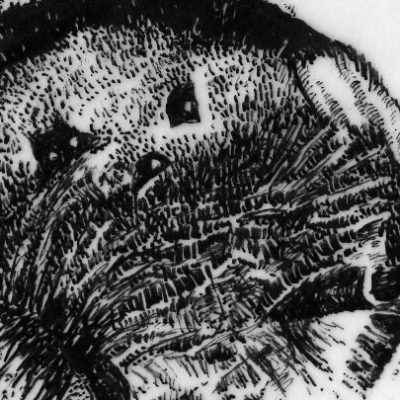
Here are my latest drawings of the bees. Earlier posts showed my sketches of  ’bee characters‘ as well as some bee drawings using the Rotring Rapidograph. Here I’m using a dip pen to draw in detail the head of a bee.

Dip pen and Indian Ink:


Above: The drawing is from a photograph of a leafcutter bee emerging from the nest, which I took I think in 2009. The nib I’m using is the Gillot 404 which I used for the ‘bee characters’. I was surprised to find that used carefully and slowly I can achieve quite a lot of detail, as you can see if you click on the thumbnail images above. The ink is again the Windsor and Newton Liquid Indian Ink, which is non-waterproof. I have found it is ideal for this work. I use a very small amount of ink on the nib each time, dipping a very little way into the ink, or applying with a small paint brush. This way I have found there have been (so far!) no disasters with blobs of ink, and it flows almost like using a pencil, if the nib is used gently and relatively slowly. Every so often, once the ink starts to dry on the nib, I rinse the nib in a small cup of water and dry it on a lint-free cloth. Paper is Bristol Board.

This is the technique I’ll be using for a while now on the bees. Despite being quite slow work, it is in fact much quicker than drawing with the Rapidograph. It also allows me to make a variety of marks including stippling, and the lines also have more variety of thickness.


Above, left: Some quick sketches of a newly-emerged leafcutter. Above, centre and right: close-up views of a larger study of a leafcutter bee, showing the variety of lines used.


Above: Gillott nib looking slightly worn – I just hope that when I start using the next one it gives me the same results, or I’m going to be very disappointed!

The close-up of the nib above was taken with my new compact camera, which I’m hoping to use to take some better photographs of the bees. I have been struggling with the older photographs of the bees I’ve taken, since they don’t have the detail that I want to record in these drawings. At the moment I’m enjoying the weather, chasing insects around the garden and getting used to the camera. I have been really pleased to find miner bees digging in my garden for the first time this year. I don’t know whether I’ve missed them before, or they’re here for the first time.

I’ll post a few of the new pictures in the photography part of the site soon. For now, there is a link below to take you to some of my earlier photographs, and information on the solitary bees.

Bee Pages with photographs and illustrations |

 | Home | About the Artist | ContactGalleries | WritingNews |

Written by Christine

May 9th, 2011 at 2:38 pm

About the bees II

with 4 comments

A little update following on from Monday’s post about the bee activity in the garden.

As the weather has continued mostly dry and warm, and getting drier and warmer, there has been more bee activity in the bamboo, with a number of solitary bees flying and mating. I have also been able to identify the types of bee, with some careful study, and a little helpful confirmation from Damian at Help Save Bees.

Some of the solitary bees currenty active in the garden:


Above: The two pictures on the left are of a female Tawny mining bee, and I think this is the same female who was here at the weekend. Haven’t seen a male so far. The more common of the solitary bees at the moment here is shown in the two pictures on the right, which I captured this morning, resting on one of the roses. It is the Early mining bee.

This bee below is probably another mining bee, Andrena carantonica, which likes to nest under paths and stones, according to this useful website: Garden Safari.

Update: I think it is more likely to be Andrena cineraria, or Ashy mining bee, see this: Information sheet. Some sites mention its bluish tinge, which certainly fits with what I saw. Unfortunately I haven’t seen this bee again.

I think all the solitary bees at the moment are types of mining bee, which make their nests underground. This is a bee I have not seen before in my garden, however this could simply be because I haven’t paid attention! However, I did quite a bit of clearing of some areas a few weekends ago, ready to plant some bee-friendly plants, and the resulting bare patches of earth may have attracted these bees. I can’t imagine I would have missed the tawny mining bee before, as she’s so very brightly coloured. I’m hoping that at least some of them nest in my garden this year. The soil is quite sandy, which I have read that they prefer.

And here below are the Early mining bees mating, captured yesterday in quite windy conditions, so I was very lucky I happened not only to spot this pair, but that the leaves stopped thrashing around long enough to get them more or less in focus:


Above:
1. Female resting on leaf, seems to be depositing pollen from her feet to the leaf.
2. Pollen can be seen on the leaf, meanwhile the male is visible, hovering above.
3. The male, smaller and more slender than the female, lands on the leaf.
4. Male and female together.

Below:
5-7. Mating takes place (in 6, the male is balancing on his wing tips).
8. The scene from slightly further out.


And just a last couple of photos for today, below. I decided to see if I could see any nesting activity for the mining bees, and came across this hole in the soil (possibly one of my least exciting photos!), which is approximately the right size for a mining bee (the diameter of a pencil). However, I didn’t see any bee activity around it, and it could just be, well, a hole of no particular importance! While I was waiting for a bee to turn up, I spotted this wasp collecting nesting material from an old piece of wood.


Since there is such a lot of bee activity this year in the garden I’ve decided to invest in a proper macro lens for my SLR. All these pictures so far have been taken with my compact camera with it’s ‘macro’ setting on. So, hopefully I’ll be getting some better quality shots on here soon.

Update 8th April: This Hairy footed flower bee, below, another solitary bee, on the white dead nettle this afternoon. This bee looks like a black bumblebee, but it darts around very quickly rather than ‘bumbling’. It could see me with the camera and was hiding quite a bit, but managed to get some rather blurred pics. I’ll try to capture it again with the new lens.


Update 12th April: Below: This male Hairy footed flower bee was in the garden today. They move very quickly, and of all the bees I have seen they are the most interested in me, often ‘buzzing’ the camera or my head while I’m trying to take a photo! This one below, was enjoying a quiet moment on an old plastic pot. Below right: you can see his cheeky-looking face, and enormous eyes.


Update 20th April: Below: I’m still not certain whether the hole in the ground had any significance, but since then I have discovered what are definitely the nests of mining bees. A couple are alongside the path (below left), while the majority are in the soil at the edge of some woodruff. I noticed one entrance two days ago, then another couple appeared the next day, and today there are about seven. I think there are at least three bees at work, but there could be more. Unfortunately they seem very sensitive to my crashing around, however quiet I try to be, and so far all I have are photographs of the bees in the entrance to the nests: below centre and right.


I will keep photographing the bees, since I want plenty of material for the bee drawings I’m working on.

All updates to the bee activity will now go in a future blog post, and extra photographs will be on my Bee Photography page.

Also – see the Bee Pages on the right hand menu!

 | Home | About the Artist | ContactGalleries | WritingNews |

Written by Christine

April 6th, 2011 at 3:19 pm

About the bees I

with 2 comments

I thought I’d update with some news about the bees – both those in the garden, and on my drawing table. However, as this post became quite long in the writing, I have decided to put the new drawings into a separate blog post (coming soon).

Improving the solitary bee houses:


Late last month I decided to improve the site of the solitary bee nests, both enlarging the number and type of nest available, and moving them from the decking, as I think that the vibrations caused by people walking about discouraged the bees last year. Above left I’m drilling holes in the untreated wood, then tidying up with sandpaper. Finally above right is the new site of the nests, sheltered under the roof of an old hedgehog house, and resting on some bricks for stability. Read more about making solitary bee houses in these new sections on the Solitary Bee Houses and Leafcutter Bees.

A tired bumblebee:


Temperatures have been increasing over the past weeks, and bee activity in general increasing with bumblebees and honeybees flying in and out of the garden. I have never been able to get a bumblebee to nest in my garden, so I have to make do with their passing visits. Last week I rescued a buff tailed bumblebee which I found in the house, upside down and appearing quite dead. However, her legs waved weakly when I touched her, and so I righted the bee in a dish and supplied her with sugar water. Above left you see the bee, and the tongue clearly against the glass and white paper of the dish. Centre: the bee rests on some fencing material before finally flying off about twenty minutes after I found her in the house. The bee above right in the fritillary was photographed a few days later – not the same bee, but quite engrossed in what she’s doing!

Some solitary bee activity:

This past Saturday there was a very warm sunny morning and many types of bees could be seen flying above the solitary bee houses, resting occasionally on the bamboo plants, where I managed to photograph a few! It was not an easy task, given that it was quite breezy and the bees were darting around very quickly in between brief rests on the leaves. But even when the bees settled it was difficult to focus on the small bees on the waving bamboo, as you can imagine. A photograph below shows the clump of bamboo which is above the nests – the bees were darting in and out of it most of the day. Click on the thumbnails for more detail.

These are not the Leafcutter bees, who will not make an appearance until early June.


The bee above left was a beautiful red colour, and the centre left shot shows the mouth of this bee, which seems built for rolling mud balls, and so I think this is a red mason bee (update – this is a tawny mining bee, identified from photographs here). Centre right a bluish bee – do you have any idea what it is? I saw both these bees (or perhaps more than one?) a few times during the afternoon. Most common was the bee above right, which was present most of the afternoon, and there seemed to be several of them. I am still finding it quite difficult to identify the various types of bees, despite referring to guides and identification charts and photographs.  There are so many variations of colour and shape, and every species seems to look different from photograph to photograph! I’m still very much learning how to tell one bee from another, so if you can identify any of these bees I’d love you to get in touch – email link is below, or there is a tab above for making comments – thanks in advance!

Other bees, flies and wasps were also enjoying the sunshine. Including this honey bee, below centre, which can be identified by the pollen sacks, and this below right, which I think is a Narcissus fly, doing a very good impression of a bumblebee.


Fabre’s Mason Bees:

Finally, for now, a little note about “The Mason Bees“, by Jean-Henri Fabre, which I spent some time reading last week. It’s a fascinating and engaging read, full of the observations and thoughts of this pioneering entomologist. It really is a series of essays which describe Fabre’s first enounter with the bees while he was a schoolteacher, and a number of his experiments and hypotheses. The entire text can be read in several places online, including here at Project Gutenberg.

An update to this page can be found here: About the bees II.

A post about the bee drawings coming soon!

 | Home | About the Artist | ContactGalleries | WritingNews |

Written by Christine

April 4th, 2011 at 3:57 pm

This year’s bees emerging.

with 2 comments

Just a little update to show you what’s happening with the leaf-cutter bees at the moment.

I think the bees are a little later than usual this year, but they have finally been hatching out over the past week. On the left is a bee coming out of its tube, while on the right is a newly-hatched bee resting before it flies away. Now if you are wondering why the tube is sitting there on a plant pot rather than in the usual bee house here’s the reason. There were not as many tubes in total sealed last year as usual (only about ten), and almost half of those had not hatched at all by this week, which seems to me to be very late. So I decided to take a look to see what was happening inside the tubes.


I took a sharp stanley knife and gently scraped away the first few discs of leaves and discovered that one of the tubes had in fact become infected with mites, which you can see in the below left picture. All the bees in that tube had died or never made it to adulthood. I removed these cells by cutting into the cardboard tube. A second tube had a dead bee in its early stages of life in the first cell. I removed this cell and then, in quick succession, the other bees came out. I managed to photograph and video some of this. I think they must have been queueing up to escape and were wondering what was happening ahead in the tube, as usually the bees will spend several minutes resting and cleaning themselves before they come out, but these seemed more than ready to fly away. I have often wondered what happens if the first few bees in the nest die, because it seems to me that the ones back in the tube would never get out.


Another thing I’ve done this year is to remove the paper lining from inside the cardboard tubes, which the bees really don’t like (above centre). Pictures in earlier posts show you the bees clearing these out themselves. I don’t know whether the paper smells oddly or what it is they don’t like about it. I also found that the manufacturers had used glue to attach the paper to the plastic end plugs which seal up the rear of the tubes. So they’ve gone too, and I think the bees will seal the far end of the tubes themselves. So above right you can see what the bee houses look like today.

A result of my fiddling with some of the empty nests allows me to show you some shots of how the cells are put together by the bees. Especially interesting to me was the way they cut two different shapes out of the leaves in order to make their cells: circular pieces to seal the ends of the cell (they use several of these, possibly as many as ten to make a little plug, below right), and a more elongated shape, which they use to form the sides of the cells:


So today I think will see the hatching of the final leaf-cutters for this year, and there is a male already buzzing around the houses waiting to mate, so hopefully I’ll get some nesting this year. Finally, here’s the video. It takes the bee a little while to come out, mainly because I’m thumping around on the decking and it can hear me… and then he comes in close to take a look at me and then flies away: 

More posts about the leaf-cutter bees, including information about their life-history, how to attract them to your garden.

And another great solitary bee blog with masses of information, pictures and videos.

 | Solitary Bee Pages |

| Home | ContactGalleries | Subscribe to Blog |

Written by Christine

June 26th, 2010 at 2:14 pm

A day at the leaf-cutter bee nests

without comments

Today I’ll be posting pictures taken of my leaf-cutter bees live at the bee tubes, which are right outside my artist’s studio. Take a look at these earlier posts to find out all about these solitary bees.

solitary bee houses outside my studio three kinds of solitary bee house

1) And here are the first pictures of the day, a leaf-cutter clearing out paper from inside one of the tubes (click on the thumbnails for a closer look):

the leaf tubes, with two already sealed leafcutter bee clears paper from a tube 

Above left: here you can see many empty (so far unused) tubes, plus ones with brown leaf debris around the outside where bees hatched last month. There are two tubes which have already been filled with eggs and ‘bee bread’ (rather than honey, which these bees do not make) – these are the tubes with fresh leaves sealing them. Towards the top left of the picture a bee can be seen clearing a new tube of paper (which is put there by the tube manufacturers) ready to begin making her nest of leaves in which she will lay eggs.

Above right: a close-up of this bee clearing the tube.

2) A second bee arrives.

another bee arrives at the tubes leafcutter searches for a tube to her liking

Above left: The first bee is still clearing a tube, when this bee arrives at the nest site. Although leaf-cutters are ‘solitary’ bees, and do not form colonies or hives like other bees, they do not mind nesting in adjoining tubes, and do not seem to fight. They are also very safe bees to have in the garden as you can see – the site of the nest is right outside my studio and next to garden chairs!

Above right: She checks out several tubes, going in and out, and nibbling around the edges, deciding whether to nest.

3) A few pictures from the end of last month, when the bees were sealing the tubes you see closed above:

bees sealing tubes with leaves nibble marks on the leaf, which has been partially cut leafcutter seals tube with leaf

Above left: Two bees at work at the tubes.

Above, centre: The leaves used to seal the tubes may be cut to shape on-site. Here the bee has gone in search of more leaves, as they build with many layers. You can see the marks where she’s forming the leaf into the correct shape, and at the same time sealing the tube.

Above, right: She returns to finish off the job.

4) Meanwhile, down in the bamboo bee nest

bee flies into bamboo tube with a leaf bee arrives at the tubes with leaf two sealed tubes... and a bee

Above left and centre: bees arrive with circles of leaf to line and seal the cells into which they lay eggs.

Above right: two of the bamboo canes fully sealed. As you can see the bees use rose petals at times as well as leaves.

Well the occasional showers have now turned into what looks like more prolonged rain… and I don’t think there will be any further activity from the bees today. Thanks for visiting, and perhaps try encouraging these fascinating creatures to your garden.

Some links:

Buy the cylinders yourself and encourage solitary bees to your garden, they’re available from WigglyWigglers, CJ Wildbird Foods, and other places online (search ‘Oxford Bee Company’).

Also, check out these articles on solitary bees, the best plants to grow for bees, and the Co-Op site on saving bees.

Follow this link to see all posts on leaf-cutter bees.

Solitary Bee Pages |

| Home | About the Artist | ContactGalleries | Subscribe to Blog |

Written by Christine

July 14th, 2009 at 11:55 am

Leaf-cutter bees clear out the nesting tubes

without comments

An update on what the leaf-cutter bees are doing at the moment. Some bees are still hatching. The clicking sound of the bees nibbling away at the dried leaf cells is very audible if you’re sitting anywhere near the tubes, so it’s easy to know when they are working their way out! Here is a previous post showing leaf-cutter bees hatching, and here you can see that they are now hatching from the wooden bee house:

freshly-sealed nests last year leaf-cutters have hatched from wooden house abandoned nest tube, 2008

I feel I must say that although this bee house above looks beautiful, as you can see the bees have not favoured it, and prefer the cylinder-type houses. The reason for this seems to be that many of the holes are simply the wrong size or shape. One bee last year attempted to nest in one of the lower holes, and gave up the attempt (see above, right). The two circular holes either side of the ones which have been nested in cannot be used at all, because there are small nails blocking the tubes. So if you are purchasing bee homes, please look out for all these things before making a selection.

Meanwhile, bees that have been about for a week or so are looking for suitable nest sites. So if you have put up some bee houses (which you can order from e.g. here or here) recently, or have nests from last year, this is the kind of thing to look out for. On the left, the bee is exploring the new tubes, centre picture she seems to have chosen to re-use one of the old tubes, and emerges with white paper, which is thrown below as debris (far right):

leaf-cutter bee explores new tubes bee emerges with paper  debris from the tubes, extracted by bees

Finally for now, one of the bees resting after emerging, and enjoying some of the garden flowers (see more plants to attract bees here):

newly-hatched bee resting leaf-cutter bee on Polemonium

Follow this link to see all posts on leaf-cutter bees.

 | Solitary Bee Pages |

| Home | About the Artist | ContactGalleries | Subscribe to Blog |

Written by Christine

June 24th, 2009 at 12:35 pm

Leaf-cutter bees outside my Studio

with 4 comments

Why attract leaf-cutter bees?

Leaf-cutter bees are incredible creatures to encourage into your garden or allotment – great to observe and look after, and they are wonderful pollinators. This kind of bee is a ‘solitary bee‘ which does not form a hive or make honey, but works alone, although they will nest side-by-side and not fight or compete. They are in fact perfect bees for the garden, and safe around children as they do not store honey and so have nothing to ‘defend’ from attack. They are quite happy to let you go right up to the nest to see what they’re doing, as you can see from these shots of a bee hatching in my garden this week (click for a closer view):

having a wash and waiting to emerge emerging bee ... and here he is! using wings for the first time

What do the bees do in the tubes..?

The tubes are just the right size to allow the bees to easily construct their nest cells, which they make from circles of leaves. The bees fly out into your garden, cut perfect circles from your rose bush leaves (see also photo below, third from left), and fly back to the nest. You can follow them around your garden as they do this! Once back at the nest, the bee will curl up the circle of leaf, and take it into the tube with her. A bee will need many leaf circles to make each cell, since she lines the sides of the tube as well as sealing both ends of each cell with many layers of leaves. Before she seals each cell, she lays one egg, and puts food of pollen ‘bee bread’ to enable the hatched larvae to eat and grow during the time the cell is sealed. All of these activities can be observed by watching the tubes during the summer. Also fun to watch are the females bees clearing out old tubes at the beginning of the season; kicking out old leaf-debris in previously-used tubes, or removing the paper inserts from newer tubes (see photo below, second from left). These bees prefer to re-use an old tube rather than re-line a completely new one with leaves, and will ignore new tubes if there are any empty, weather-beaten tubes to re-colonise!

The life-cycle of leaf-cutter bees, in brief: The young bees emerge from their nests in June, and mate. After this the males die, and the females begin the work of nesting and laying eggs. Once sealed into the cells the eggs hatch, and the larvae feed on the ‘bee bread’, grow, pupate and develop into the bees which then hatch almost a year after they were laid as eggs. These newly-hatched bees mate, lay their eggs, and die before the summer is over, never seeing their off-spring.

How can I start encouraging solitary bees into my garden?

Where to buy the nests: The Oxford Bee Company who originally sold the cylinders and tubes is no longer trading, but cylinders and tubes can be purchased from various places online, for example WigglyWigglers and CJ Wildbird Foods. Or search online for ‘Oxford Bee Company’ for other suppliers. You can also make nests yourself out of old garden canes and similar stems, or by drilling holes in a block of wood, and these are successful. But I have found that the bees can be a little fussy about the diameter of hole they prefer, and many of the tubes may go unused if they are too big or too small – however these may be used by other bees or insects. I have had mason bees (which make their cells out of mud) nesting alongside the leaf-cutters in my nests.

Siting: The first year I tried the cylinders I attached them to a sunny wooden fence, but while there was some interest from bees that summer, none of them nested. I have since found that the bees do not particularly like the tubes when they are new, and prefer them to be somewhat weathered. However, I have also heard that the vibrations caused by the fence moving in the wind may also have discouraged them from settling. So I have followed advice to place the cylinders in a stable and sunny spot, a few feet from the ground, and preferably somewhere the tubes won’t get wet.

a variety of solitary bee houses debris from the 'clearout' last summer neat circles made by leafcutters newly-emerged leafcutter on flower

Plants to grow: There is a very useful site here which lists the kinds of plants that bees love. Obviously, leaf-cutters also like roses from which to harvest nest material, but they will use other similar plants and of course fly around the neighbourhood in order to locate suitable leaves! And equally obviously don’t use chemical sprays in the garden, as these are poisonous to bees; consider gardening Organically with wildlife controls, barriers, etc., it really is the only way if you want to encourage any kind of wildlife.

Over winter: Once the summer is over and the tubes are all sealed, you will need to put the cylinders somewhere dry and cool for the bees to over-winter. A garden shed seems ideal, but don’t forget to take them out again next Spring! Once Spring comes, re-position your cylinders where they were the previous year, and wait for the new bees to hatch. My leaf-cutters begin to hatch in the first weeks of June, towards Midsummer.

Lastly: Don’t be discouraged if no bees nest in the first year. It may well take a little while for them to find the nests and settle in. Also, you will find that if you stop spraying chemicals in your garden, and plant more of the bee-friendly plants, you will see a definite increase in bees and other interesting wildlife in your garden anyway!

Also, check out these articles on solitary bees, the best plants to grow for bees, and the Co-Op site on saving bees.

Follow this link to see all posts on leaf-cutter bees.

 | Solitary Bee Pages |

| Home | About the Artist | ContactGalleries | Subscribe to Blog |

Written by Christine

June 18th, 2009 at 10:16 am